ADHD and Sleep: Why they don't get along and what helps

Quick answer: ADHD and sleep problems travel together. A 2024 study of 3,691 adults with ADHD found about 60% screened positive for at least one sleep disorder, most often trouble falling asleep, insomnia, and restless legs.
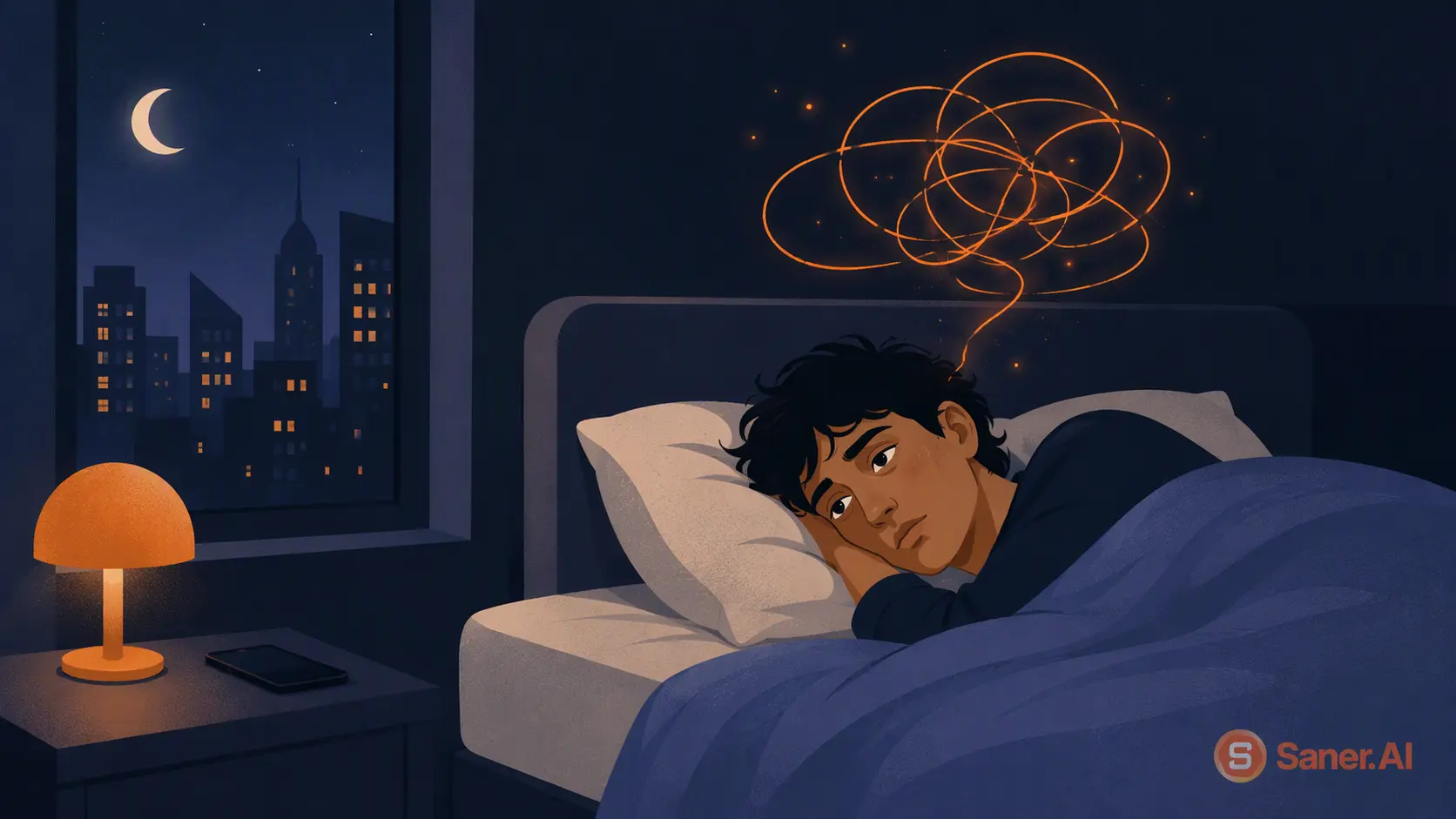
It's 1:00 a.m. You meant to be asleep two hours ago. Your body is wrecked, but your brain just opened 7 new tabs, three of them about a hobby you didn't have yesterday.
For a lot of people with ADHD, bedtime feels less like winding down and more like a negotiation you keep losing. Then the morning arrives, alarm number four goes off, and the day starts already behind.
This isn't a willpower problem. There's real biology behind it, and a decent amount of research on what helps. Below is what the science says, minus the jargon, plus the stuff that's practical enough to try tonight.
1) How common are sleep problems with ADHD?

- In a 2024 Dutch study of 3,691 adult ADHD patients, about 60% screened positive for at least one sleep disorder. Broken down, 36% had delayed sleep onset, 31% had insomnia, and 29% had restless legs or limb movement problems.
- Insomnia estimates swing a lot between studies, but they're high. Earlier reviews put insomnia in adults with ADHD anywhere from 43% to 80%, depending on how it was measured.
- The night owl pattern is close to the default. In an interview study of 120 adults with ADHD, 78% had trouble getting to bed on time, often landing somewhere between 1 and 3 a.m., and close to 70% had trouble falling asleep.
- It shows up on sleep trackers too, not only in how people feel. A meta-analysis comparing adults with and without ADHD found longer time to fall asleep and lower sleep efficiency on wrist actigraphy.
2) Why ADHD brains fight bedtime?

Your body clock may run late
Your brain starts releasing melatonin when it gets dark, and that release (researchers call it dim light melatonin onset) is the body's cue that sleep is coming. In adults with ADHD, that cue tends to arrive late.
A 2010 study in Biological Psychiatry found that adults with ADHD and chronic sleep-onset insomnia had a delayed melatonin onset and a later start and end to their sleep compared with healthy adults. Psychiatrist Sandra Kooij, one of the researchers behind that work, explains it: most adults start making melatonin around 9:30 p.m., but in adults with ADHD it comes about 90 minutes later, and falling asleep after that point takes them at least three hours instead of the usual two.
So when someone with ADHD says "I'm just not tired at 10," they may be describing their biology pretty accurately.
Your brain is still running at full speed
The Sleep Foundation notes that even people who aren't physically hyperactive during the day can get racing thoughts and bursts of energy at night. Night is also quiet, which makes it the perfect time to hyperfocus.
"Revenge bedtime procrastination" hits harder
This is the feeling: the day belonged to everyone else, so the night is finally yours, and you're not giving it up for something as boring as sleep. Researchers have measured this.
- In a study of 553 university students, those with probable ADHD scored higher on bedtime procrastination and insomnia, and slept less.
- A 2026 pilot study of adults with ADHD symptoms found that an evening chronotype and problematic gaming were each linked to more bedtime procrastination.
Then add time blindness and the difficulty of switching from one activity to another. Stopping something interesting to go to bed is a transition, and transitions are hard for ADHD brains.
Anxiety, low mood, and other things in the mix
Sleep problems in adults with ADHD often travel with other conditions. The 2024 Dutch study linked them to depression, anxiety, substance use, personality disorders, and PTSD. If something else is going on, treating the sleep alone may not be enough.
3) Sleep disorders that often show up alongside ADHD

Sometimes "bad sleep" is actually a sleep disorder. These are the ones that come up most with ADHD:
- Insomnia: trouble falling asleep, staying asleep, or waking up unrefreshed. In one recent study of adults with ADHD, 63.9% had at least one insomnia symptom and over 44% met full criteria for insomnia disorder.
- Delayed sleep-wake phase disorder: where your whole sleep window is shifted two or more hours later than normal. You can sleep fine, just not at the hours the world wants. The Sleep Foundation describes it as one of the circadian rhythm disorders most commonly reported in people with ADHD.
- Restless legs syndrome and periodic limb movements: that crawly urge to move your legs right as you lie down. It turned up in 29% of adults in the 2024 Dutch sample, and researchers have looked at iron and dopamine as a shared link.
- Sleep-disordered breathing, including snoring and sleep apnea: A meta-analysis found a clear link between ADHD and sleep-disordered breathing in children, and untreated apnea causes daytime fog that looks a lot like ADHD.
- Narcolepsy is rarer, but the Sleep Foundation notes that adults with narcolepsy are about twice as likely to report childhood ADHD symptoms.
If you snore loudly, wake up gasping, kick through the night, or feel exhausted no matter how long you sleep, that's worth bringing to a doctor.
4) What about ADHD medication?
It depends on the person, and on timing.
- In children, a 2015 meta-analysis in Pediatrics found that stimulants led to longer time to fall asleep, lower sleep efficiency, and shorter sleep. The effect on falling asleep got bigger with more doses per day and eased the longer kids stayed on the medication.
- Lead author Katherine Kidwell summed up the bigger picture this way: "Poor sleep makes ADHD symptoms worse."
- On the other hand, some people find their racing thoughts calm down on medication, which can help them settle at night.
If you suspect your medication is affecting your sleep, don't change it on your own. Talk to your prescriber about dose timing, release type, or a non-stimulant option.
What actually helps (ADHD-friendly sleep tips)
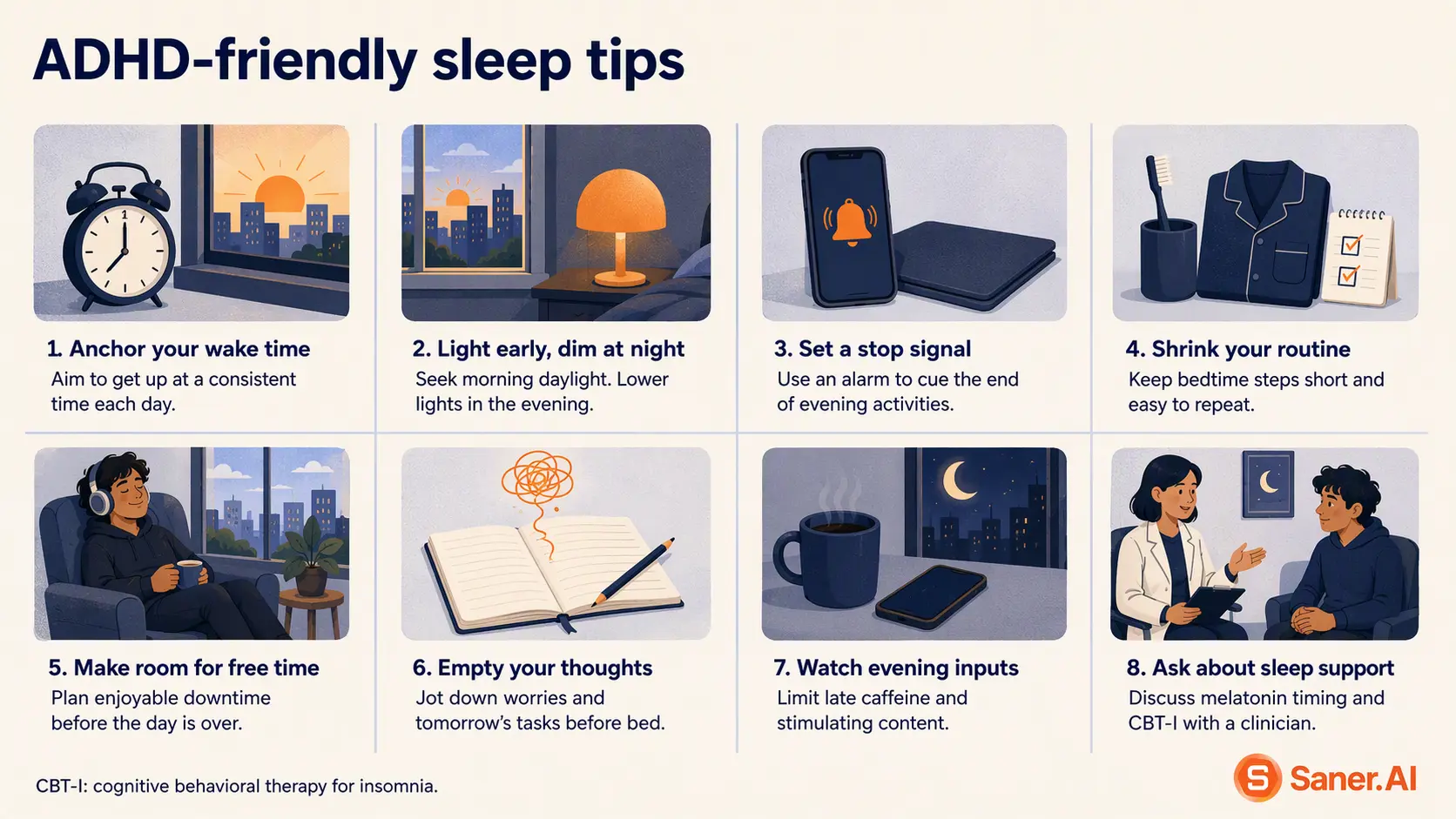
1. Anchor your wake time, not your bedtime
A fixed wake-up time, even on weekends, is the strongest lever you have on a late-running clock. Bedtime tends to follow once your mornings are steady. The Sleep Foundation recommends going to bed and getting up at the same time every day, choosing hours you can realistically keep.
2. Get bright light early, and dim it at night

Light is the main signal your body clock listens to. Switch to warm, low lamps after dinner. Screens are a double hit here, since the light delays melatonin and the content keeps your brain busy.
3. Set an external "stop" signal
Time blindness means "I'll go to bed soon" doesn't work. Use something outside your head instead:
- An alarm that goes off one hour before bed, labeled with exactly what to do next
- Smart lights that dim automatically at a set time
- A last task of the day that's small and specific, so stopping feels like finishing
4. Shrink the bedtime routine
Pick two or three steps you actually enjoy, like a shower, a familiar book, or a podcast you've heard before. Familiar beats novel at night
5. Give yourself some free time during the day
If your evenings are the only part of the day that feels like yours, of course you'll protect them. Building small pockets of "nothing required" time into the afternoon can take some of the pressure off midnight
6. Dump your brain before bed
Racing thoughts are often unfinished business: emails you need to send, an idea you don't want to lose, tomorrow's to-do list. Getting them out of your head and onto a page (or an app) gives your brain permission to drop them.
7. Watch the evening inputs
The usual suspects apply: cut sugar, caffeine, and alcohol a few hours before bed, and save hyperfocus-heavy projects for earlier in the day. Some people also find a weighted blanket helps them settle.
8. Ask about melatonin and CBT-I
Two treatments have real evidence behind them, but both are better done with a professional's input:
- Melatonin, at the right time. Kooij notes that melatonin isn't addictive and has worked for teens and children with ADHD who struggle to fall asleep. Ask a doctor or pharmacist about timing and dose before starting, especially if you take other medication.
- CBT-I (cognitive behavioral therapy for insomnia). It's the recommended first-line treatment for chronic insomnia. In a Swedish pilot of CBT-I adapted for adults with ADHD, insomnia scores dropped by 4.5 points right after treatment and 6.8 points at three months on a 28-point scale.
When to talk to a doctor
Try the habit changes for a few weeks, but don't wait forever. It's worth booking an appointment if:
- You've had trouble sleeping at least three nights a week for three months or more
- You snore loudly, stop breathing, or wake up gasping (a partner may notice first)
- Your legs feel crawly or jumpy when you lie down
- You fall asleep during the day without meaning to, especially while driving
- You think your ADHD medication is keeping you up
- Low mood or anxiety is part of the picture
Final thoughts:
If you've spent years blaming yourself for being "bad at sleep," I hope this takes a little of the weight off.
They're also workable. Start with one change, give it two weeks, and bring a doctor in for anything that looks like a sleep disorder.
A lot of what keeps ADHD brains awake is open loops. The email you forgot to answer, the idea you don't want to lose, the vague dread about tomorrow.
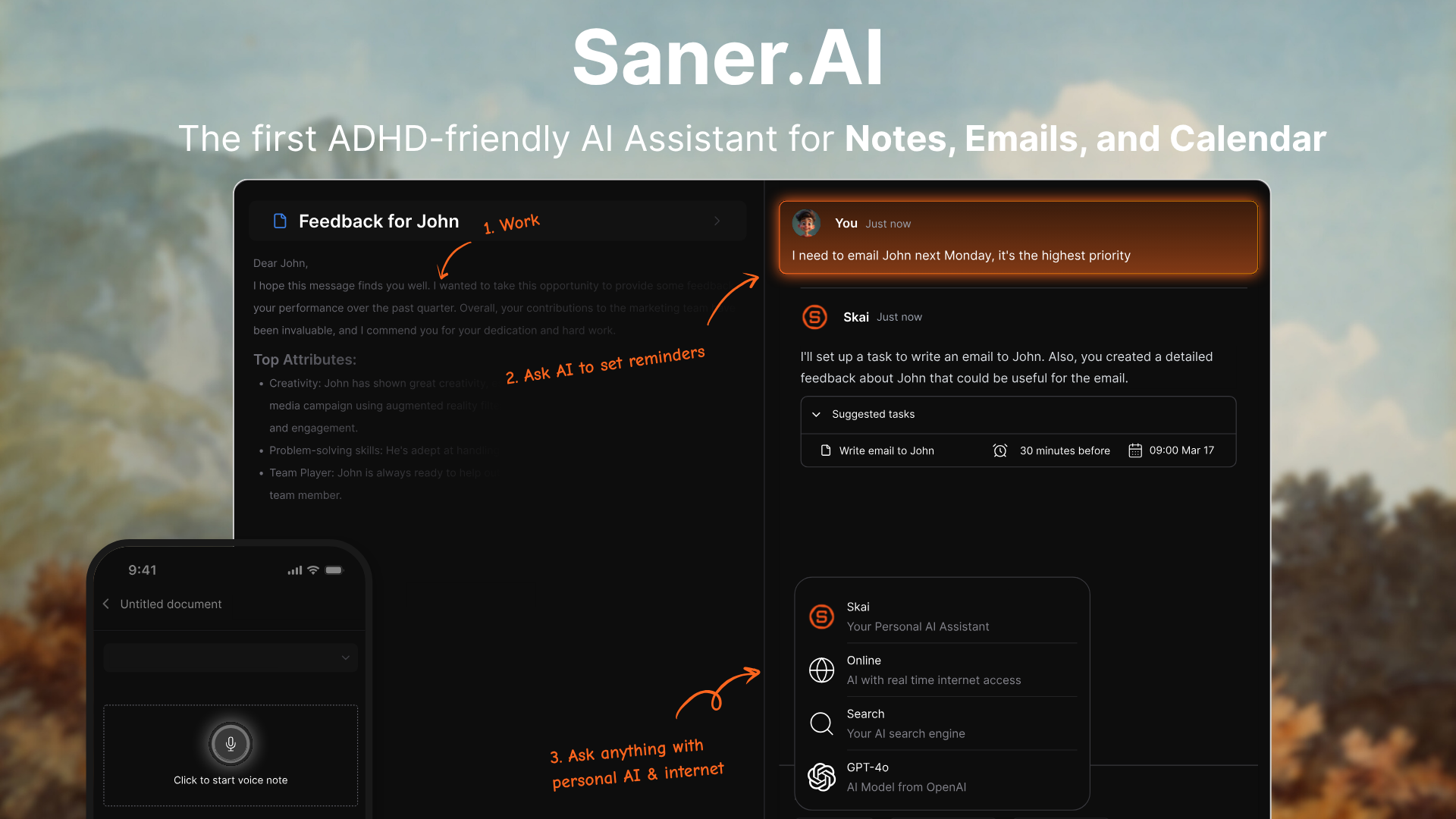
That's where a tool like Saner.AI can quietly help. It's an AI personal assistant built for people with ADHD (one of its co-founders has ADHD himself)
Here's how it fits into a better night and an easier morning:
- Brain dump before bed: Type or voice-note everything spinning in your head, and Saner turns brain dumps into tasks and plans so your brain can stop rehearsing them.
- Close the day with a real stopping point: Ask it to schedule tomorrow's top tasks, and the "I'll just finish this one thing" urge loses its grip, because the next step already has a home.
- Wake up to a plan: Saner proactively plans your day and checks in, which helps on groggy mornings when deciding what to do first feels impossible.
Stay on top of your work and life effortlessly
ADHD and Sleep FAQ
Why can't I sleep if I have ADHD?
Usually it's a mix of a delayed body clock (melatonin arrives later than average), a brain that stays busy at night, and difficulty stopping enjoyable activities. Sleep disorders like insomnia, restless legs, or sleep apnea are also more common with ADHD and may need treatment of their own.
Do people with ADHD need more sleep?
There's no strong evidence that they need more. The goal is the amount recommended for your age group, on a steady schedule. The problem for people with ADHD is usually getting enough sleep at the right time, not needing extra.
Can lack of sleep make ADHD worse?
Yes. Poor sleep worsens focus, memory, and mood, which are already hard with ADHD. The relationship runs both ways, so tired days can feel like your ADHD is getting worse.
Can sleep deprivation be mistaken for ADHD?
It can. Symptoms overlap a lot, which is why doctors often screen for sleep problems before prescribing ADHD medication.
Is revenge bedtime procrastination an ADHD symptom?
It isn't an official symptom or diagnosis, and anyone can do it. But studies show people with more ADHD symptoms delay bedtime more often, likely because of time blindness, impulsivity, and trouble with transitions.
Does melatonin help ADHD sleep problems?
For some people, especially those who struggle to fall asleep. Research shows melatonin and morning light can shift a late body clock earlier. Check timing and dose with a doctor or pharmacist first.
Does fixing sleep fix ADHD?
Honestly, not by itself, at least according to the newest evidence. A 2026 randomized trial of 70 adults with ADHD and a sleep disorder found that adding sleep treatment to standard ADHD care didn't significantly reduce ADHD symptoms more than ADHD care alone.
👉 You may like this post on how to improve Productivity for adults with ADHD
Sources
This article is for general information and isn't medical advice. Talk to a qualified clinician about your own sleep and ADHD treatment.
- van der Ham M, et al. (2024). Sleep problems in adults with ADHD: prevalences and their relationship with psychiatric comorbidity. Journal of Attention Disorders, 28(13), 1642-1652.
- Staley BS, et al. (2024). ADHD diagnosis, treatment, and telehealth use in adults, United States, 2023. CDC MMWR, 73(40).
- van Veen MM, et al. (2010). Delayed circadian rhythm in adults with ADHD and chronic sleep-onset insomnia. Biological Psychiatry, 67(11), 1091-1096.
- Díaz-Román A, Mitchell R, Cortese S. (2018). Sleep in adults with ADHD: systematic review and meta-analysis of subjective and objective studies. Neuroscience & Biobehavioral Reviews.
- Kidwell KM, et al. (2015). Stimulant medications and sleep for youth with ADHD: a meta-analysis. Pediatrics, 136(6), 1144-1153.
- (2026). The effects of sleep treatment on symptoms of ADHD, sleep quality, fatigue, and depressive symptoms in adults. Journal of Attention Disorders, 30(3), 354-369.
- Fargason RE, et al. (2017). Correcting delayed circadian phase with bright light therapy predicts improvement in ADHD symptoms: a pilot study. Journal of Psychiatric Research, 91, 105-110.
- Jernelöv S, et al. (2019). Effects and clinical feasibility of a behavioral treatment for sleep problems in adult ADHD. BMC Psychiatry.
- Cullen M, et al. (2025). Effectiveness of CBT-I in individuals with neurodevelopmental conditions: a systematic review. Journal of Sleep Research.
- Bahar A, Uygur ÖF. (2023). The relationship between ADHD symptoms and bedtime procrastination. Journal of Contemporary Medicine.
- Erdoğan Aktürk B. (2026). Internet gaming disorder severity and chronotype in relation to bedtime procrastination among adults with ADHD symptoms. Bağımlılık Dergisi, 27(2).
- Sedky K, Bennett DS, Carvalho KS. (2014). ADHD and sleep disordered breathing in pediatric populations: a meta-analysis. Sleep Medicine Reviews.
- Kooij S. Sleep and ADHD. APSARD.