Muse AI Alternatives: We tested the best 6 apps


Meta’s Muse can browse the web, create documents, monitor prices, manage reminders, and complete tasks through connected apps. That gives it broad reach, but the best personal AI assistant depends on what you actually want it to handle. Some people need help turning scattered notes and emails into a plan. Others care more about calendar management, accountability, privacy, or running custom automations.
We evaluated six Muse alternatives to see where each one fits. We’ll compare how each assistant handles everyday work, how much access it needs, where you can use it, and how much setup is involved.
Quick guide: What are the best Muse AI alternatives?

- Saner.AI: Best assistant for organizing notes, emails, tasks, and calendar automatically
- Tomo AI: Best for personal accountability, habits, and proactive check-ins over text
- Poke: Best for managing email and calendar tasks through your messaging apps
- Town AI: Best for professionals who want recurring executive-assistant workflows
- OpenClaw: Best for technical users who want a self-hosted and customizable assistant
- Folk: Best for personal admin, persistent memory, and planning through group chats
What is Muse AI?

Muse is Meta’s personal AI agent for handling everyday tasks across the web and connected apps. You can chat about your request, and it will research topics, create documents and images, manage reminders, monitor prices, make purchases, and work through multi-step requests in the background.
Its broad feature set makes it a general-purpose assistant, though people who need stronger note management, accountability support, or more control over their data may prefer a specialized alternative.
How we chose the best Muse AI alternatives
A useful Muse alternative should do more than answer questions. It needs to remember relevant context, work with the apps you already use, and complete tasks without creating more admin. We compared each assistant using the following criteria:
- Task execution: Can it take action, or does it mainly provide instructions and suggestions?
- Integrations: Which email services, calendars, messaging platforms, and productivity tools can it access?
- Memory: Can it retain your preferences and use earlier conversations when helping with new requests?
- Proactivity: Does it send useful reminders, monitor changes, and run scheduled routines without repeated prompting?
- Ease of use: How quickly can you set it up, and how much maintenance does it require?
- Privacy and control: Where is your information stored, which permissions are required, and can you approve sensitive actions?
- Specialization: Does it serve a clear need, such as ADHD-friendly planning, habit support, executive assistance, or self-hosted automation?
- Value: Are its paid features useful enough to justify the subscription and any additional model or hosting costs?
What are the Best Muse AI alternatives?
Best Muse AI alternatives in 2026 are Saner.AI, Poke, Town, Tomo, Lindy, OpenClaw
1) Saner.AI

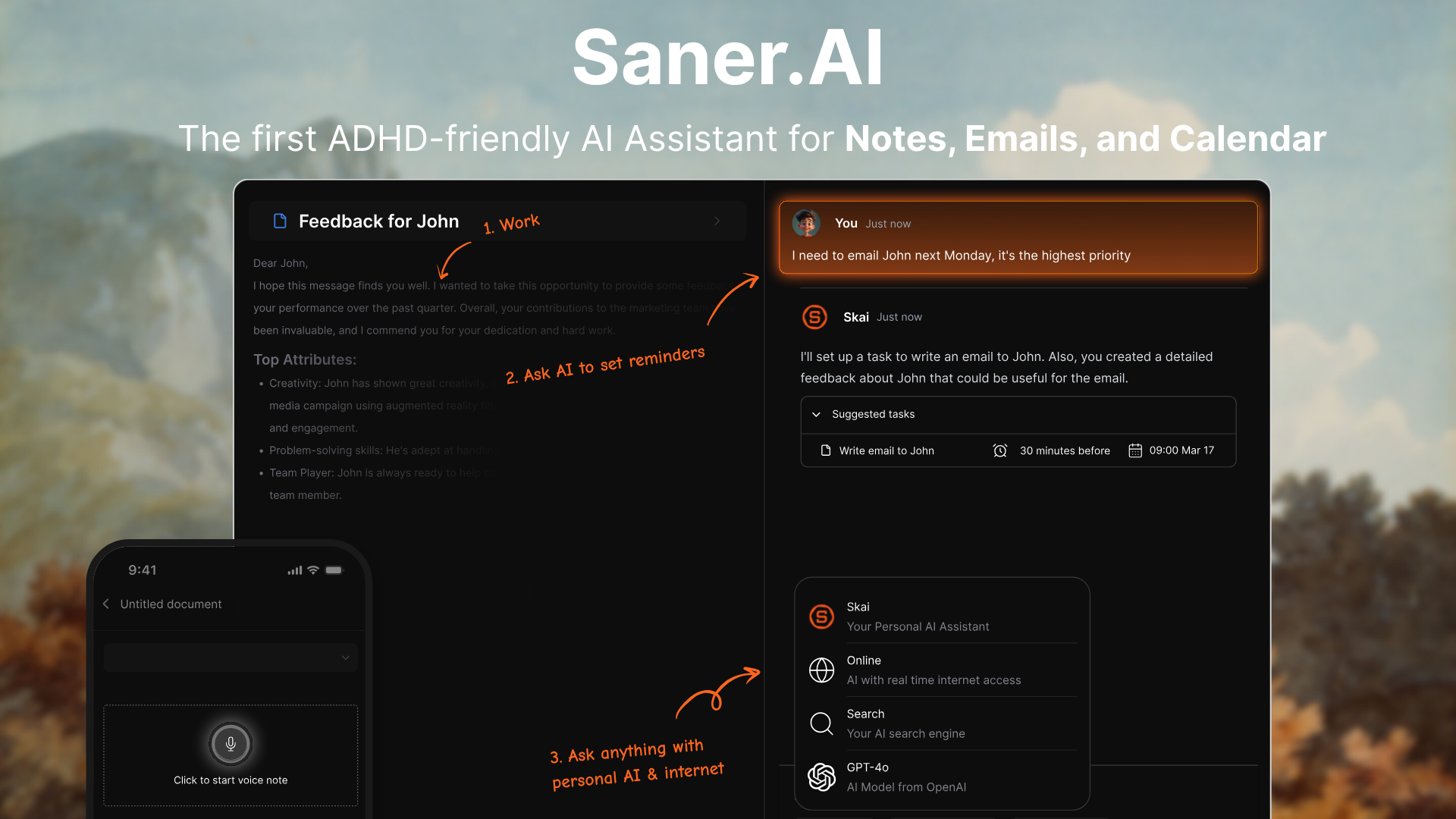
You open a chat in Saner.AI, dump whatever's stuck in your head, and it sorts the mess into tasks, times, and a schedule on its own. No browser session running in the background. No "approve this purchase" pop-up. Just a planner that already moved before you asked it to: check your morning, and today's plan is sitting there, built from your calendar, your open tasks, and whatever you braindumped the night before.
Key Features
- AI chat that actually knows your stuff (Skai): Ask it a question in plain language, and it searches across your notes, emails, and tasks instead of making you remember which app you put the answer in.
- Braindump-to-task conversion: Talk, type, or paste a wall of text and it splits the mess into individual tasks with suggested due dates, instead of leaving you to sort it by hand.

- Proactive daily planning: Every morning, it builds a suggested schedule from your calendar and open tasks, then reprioritizes as the day actually goes

- Unified capture across your tools: Gmail, Google Drive, Slack, and Calendar all feed into one inbox, so an idea from a meeting and a task from an email land in the same place.

Pros
- I stopped losing ideas the second I said them.
- I didn't have to restructure how I think to use it. It works with a messy brain dump instead of demanding folders and tags up front.
Cons
- The mobile app lacks full feature parity with the web version for complex workflows
- It's a younger product, so it doesn't have feature depth
Pricing
- Free — $0
- Starter — $8/month (billed annually)
- Standard — $16/month (billed annually)
What Users Say
"It helps a lot to keep all tasks neatly organized... I consider it as my life manager." — Maria (Sealit), Product Hunt

Suitable for
- Best for: knowledge workers and ADHD/neurodivergent users who want one place for notes, tasks, and email instead of three apps and constant tab-switching
- Best for: people who want the "AI plans my day" outcome Muse promises, without connecting payment methods or a full inbox to a third-party agent
- Not for: teams needing shared workspaces or heavy customization — Saner.ai is built around a single person's workflow, not collaboration
How to Get Started
- Sign up for free and connect at least one source — Gmail or Google Calendar gets you the most out of the proactive planning from day one.
- Spend your first session just brain-dumping: talk through your open tasks for five minutes and watch Skai sort them
2) Poke

I find myself using Poke AI with a mix of relief and occasional skepticism. On one hand, offloading routine tasks directly from your text messages shifts how you handle your workday. On the other hand, trusting an automated tool to handle your actual inbox and scheduling takes a bit of a leap of faith
What it does well:
- Proactive messaging and background execution: Poke AI does not sit around waiting for you to type a prompt; it monitors your connected tools and sends updates or reminders straight to iMessage, WhatsApp, or Telegram
- Messaging-native: You chat with it as you would a colleague via text or voice note, eliminating the friction of logging into a separate dashboard
- End-to-end task execution: Beyond simple search or text generation, it executes actions across connected systems.
"What I like best about Pokee AI is that it can actually complete tasks instead of only giving suggestions." — Verified Review
- Deep custom extensibility: Power users can wire up custom workflows through API triggers, webhooks, and Model Context Protocol (MCP) servers to extend its reach into custom toolchains.
What it doesn't do well:
- Requires explicit safety boundaries: Granting write access to your inbox or calendar can feel risky without setting up confirmation checkpoints
- Lack of a visual workspace: Because it lives within messaging threads, users who prefer spatial visual boards, canvas layouts, or traditional document editors may find text-only management cramped.
- Usage-based limits and tier restrictions: Advanced background automations and frontier model usage require higher paid tiers or usage credits
Who it's actually for: Mobile-first professionals and busy builders who want a proactive assistant to execute tasks over chat rather than managing another open browser tab.
3) Folk

Folk is a personal AI agent that works inside iMessage, Telegram, WhatsApp, and Discord. It can manage your calendar and inbox, remember personal context, track goals, and complete online tasks.
Where Folk stands out
- Fast, text-based setup: Folk works as a contact inside supported messaging apps, so there is no separate interface to learn.
- Calendar and inbox assistance: Folk connects the conversational experience to practical work, including scheduling, inbox management, reminders, and drafting.
- Low learning curve: You give Folk instructions by sending ordinary messages rather than building workflows or writing detailed prompts.
- Long-term personal memory: Folk is designed to remember tasks, preferences, and earlier conversations.
- Proactive task execution: Folk can book restaurants, watch flight prices, manage reminders, browse the web, and run scheduled automations.
Where Folk falls short
- Its default tone may be too casual: Folk is deliberately styled like a friend in your texts, which may not suit professional communication.
One reviewer noted that its grammar could feel "a bit unprofessional", particularly when Folk writes emails on the user's behalf.
- Independent review coverage is limited: Folk is a relatively new product,
- Useful features require broad access: Calendar, email, location, and booking features become more capable when Folk can access sensitive accounts and personal context.
Who Folk is best for: Folk is best for people searching for the best Muse AI alternatives that work through familiar messaging apps. It is especially useful if you want an AI assistant to remember ongoing context, manage everyday admin, and follow up without requiring another dashboard.
4) Tomo AI

Tomo AI is for people who want help following through on personal goals. Like Muse AI, Tomo remembers your goals and provides ongoing support, but its main strength is accountability through familiar text conversations rather than broad autonomous tasks such as web browsing, shopping, and document creation.
What it does well
- Reminders for routines and everyday tasks: Tomo can support recurring commitments and provide reminders that keep daily priorities visible.
- Conversational support through text: Tomo works like a personal AI companion you can talk to naturally
"The accountability is real, the banter keeps it fun, and it actually helps you execute instead of just talking."- Verified review on Trustpilot
- Personalized action plans: You can tell Tomo what you want to accomplish and use the conversation to turn an unclear ambition into practical next steps.
- Goal tracking and accountability: Tomo remembers what you are working toward, breaks larger goals into manageable steps, and checks on your progress.
What it doesn't do well
- Narrower agent capabilities than Muse AI: Muse can browse the web, create documents, connect to services, make purchases with approval, and continue multi-step work in the background.
- Proactive messaging may be inconsistent: Although reminders are an important part of Tomo's appeal, another App Store review reports that the assistant could not initiate texts. People who need dependable, automatic check-ins should confirm how this works during onboarding.
- Task execution can be unreliable: Tomo may be a weaker choice when you need an agent to perform administrative tasks across several apps.
- Message and response limitations: Some users report slow responses and daily usage caps. One App Store reviewer says,
"Tomo is extremely slow at replying, and you're limited to only 75 messages a day."
Who it's actually for: Tomo AI is for people who want a friendly accountability coach in their text messages.
5) Town AI

Town AI offers an autonomous personal assistant feature that acts as a digital worker—learning your habits to manage schedules, draft emails, and handle routine workflows across your entire tech stack.
What it does well:
- Deep cross-app automation: Connects directly with tools like Gmail, Slack, and Google Calendar so your assistant can draft emails in your voice or work down a task list.
- Adaptive work style learning: Instead of following rigid templates, it observes how you interact, client preferences, and tone to mimic your personal style.
- Human-in-the-loop approval queue: Keeps pending outbound emails and scheduled calendar modifications inside an explicit review list before taking action.
What it doesn't do well:
- Credit metering unpredictability: Higher usage and background automation runs consume credits, making monthly usage expenses variable.
- Lack of custom skill building: You are tied directly to the built-in integrations without a way to build specialized custom extensions or self-host.
Who it's actually for: Busy professionals and founders who want an AI agent to clean up their inbox and manage daily admin routines
6) Open Claw
Testing OpenClaw left me with mixed feelings. On one end, watching an autonomous agent actually carry out tasks on your device via messaging apps feels straight out of sci-fi. On the other end, setting it up via the terminal without a traditional graphical user interface can make you want to throw your router out the window.
What it does well:
- Multi-channel chat interface: OpenClaw connects directly to over 20 messaging platforms—like Telegram, WhatsApp, and Slack—allowing you to trigger tasks and manage your workflow without opening a new browser tab.
- Self-hosted privacy and data control: Everything runs on your own machine or private server, meaning your logs, sensitive files, and execution history never sit on a third-party corporate server.
- Proactive cron scheduling: It can run background tasks on scheduled cron jobs, sending you updates or completing chores on its own time.
- Self-learning skill architecture: You can teach it new capabilities in plain language using skill files, and it can even write its own modular skills when faced with new tasks.
What it doesn't do well:
- High technical barrier: Setting up gateways, reverse proxies, and API configurations requires command-line comfort, which quickly deters non-technical users.
- Unpredictable token usage and API costs: Chatting heavily with flagship models can burn through third-party API credits rapidly if you do not manually constrain model usage.
- Risk of over-autonomous execution: Giving an agent system-level authority means it can misinterpret vague instructions or execute unnecessary reasoning loops without asking for clarification.
Who it's actually for: Developers, technical power users, and privacy advocates who want an autonomous AI assistant integrated into their existing chat channels without cloud lock-in.
Conclusion
The space has blown up with dedicated tools that handle the heavy lifting just as well, if not better, depending on how you like to work.
Tools like OpenClaw and Poke, Folk give you total control over local automation and quick messaging setups, while Tomo and Town AI bring unique spins to personal productivity and structured routines.
That said, if you're like me and your biggest headache is just keeping track of scattered notes, messy action items, and an ever-shifting calendar, Saner.AI is worth a look. Instead of forcing you to set up complex triggers or manage a dozen channels, it organizes your mess, pulls out key tasks automatically, and gives you a clear daily view.
Stay on top of your work and life effortlessly
Frequently Asked Questions
1) What are the main reasons people look for Muse AI alternatives?
Muse AI tries to cover a lot of ground, but it often feels bloated if you only need specific features. Some users want simpler canvas tools, while others need dedicated AI note-taking or automated task managers. The pricing structure and performance bottlenecks on large project boards also push people to look elsewhere.
2) What is the easiest alternative for quick, conversational AI note-taking?
Saner.AI works really well here. Instead of forcing you to build complex database setups or manage rigid folders, it lets you capture thoughts through quick text or voice notes. Its AI automatically tags, connects, and retrieves your information when you ask for it later, which takes a lot of cognitive load off your hands.

3) Is Town AI good for team collaboration?
Town AI focuses heavily on shared workspaces and asynchronous communication. It gives remote teams a structured environment to log updates, track project progress, and manage internal docs together without needing endless video calls.
4) How does OpenClaw compare to Muse AI?
OpenClaw takes an open-source, highly customizable approach. If you like tweaking your tools, building custom integrations, or keeping complete ownership of your data, OpenClaw is a great fit. It requires a bit more technical comfort to configure compared to out-of-the-box platforms like Muse AI.
5) Can Poke handle quick micro-tasks and reminders?
Poke is built for speed and light interaction. It sits quietly in your workflow to help you grab quick thoughts, set short reminders, and process small tasks before they pile up and distract you from main projects.
6) Are there open-source or privacy-focused alternatives to Muse AI?
OpenClaw is one of the top choices if privacy and local control matter to you. Because it is open-source, you can self-host your setup and ensure your sensitive project data never touches third-party servers.
7) Do these tools require a heavy setup process?
It varies by app. Tools like Saner.AI and Poke are designed to work immediately out of the box with zero manual tagging or folder creation. On the other end, OpenClaw requires setup time to tweak its workflows and integrations to your exact liking.
8) How do I decide which Muse AI alternative to pick?
Match the tool to your biggest headache:
- Pick Tomo if you want visual, canvas-style ideation.
- Choose Saner.AI if you want zero-friction note capture and automated organization.
- Go with Town AI if you need clear team communication.
- Select OpenClaw if you want full code-level control over your data.
- Use Poke if you just need light, rapid micro-task management.
Stay on top of your work and life effortlessly