
ADHD Forgetfulness: Why things slip your mind and how to keep track using one app

You remember the email while brushing your teeth. You meant to reply yesterday, but you opened it between meetings, decided to come back to it, and haven't thought about it since.
You even wrote yourself a note. Somewhere.
ADHD forgetfulness can involve missed commitments and the frustrating experience of knowing you saved something without being able to find it. The National Institute of Mental Health (NIMH) lists "trouble remembering daily tasks" among the symptoms adults with ADHD may experience.
This guide explains what research tells us about ADHD and memory, offers practical ways to handle everyday forgetting, and shows where an AI assistant like Saner.AI can fit
The quick answer: What helps with ADHD forgetfulness?
ADHD can affect working memory and the processes involved in carrying out future intentions. These difficulties vary between people and across tasks. Research in adults supports working-memory differences at the group level, but that doesn't mean every person with ADHD has the same memory problems.
A practical starting point is to:
- Capture commitments as they arrive, using a place you can reach easily.
- Add a specific action and a useful reminder time.
- Keep the original information close to the task.
- Get professional support when symptoms interfere with daily life.
NIMH recommends writing down reminders and important information, maintaining routines, and breaking large tasks into smaller steps.
Why ADHD can make everyday remembering difficult
1) Working memory helps you hold information while using it
A 2013 meta-analysis of 38 studies found moderate-sized differences between adults with ADHD and comparison groups in both phonological and visuospatial working memory. These involve working with verbal or sound-based information and visual or spatial information.
That finding helps explain why a seemingly simple request can become difficult when it contains several steps. It also needs context: the researchers found that differences in testing methods helped explain variation in the results.
Remembering something easily in one situation doesn't rule out genuine difficulty in another.
2) Remembering to do something later involves more than recall
A 2013 study in PLOS ONE compared 45 adults with ADHD who were not taking stimulant medication with 45 matched adults without ADHD. Participants had to plan and later perform a complex set of tasks.
The authors concluded:
"Impairments of prospective memory mainly emerged from deficient planning abilities in adults with ADHD."
For everyday support, that suggests looking closely at how a commitment becomes an action. "Handle the insurance" leaves a lot to reconstruct later. "Open the renewal email and check the deadline" gives you somewhere specific to begin.
Where forgetfulness shows up in an ordinary day
- You read a message and intend to respond when you're at your computer. By then, it has slipped your mind.
- You leave a meeting with a clear understanding of your responsibility, but never transfer it into your task list.
- You save a useful document and later remember its content, but not its title or location.
- You remember an appointment while getting ready, then become distracted in something else and miss the time to leave.
These are examples, not a diagnostic checklist. What matters for choosing support is identifying the point where information becomes difficult to keep track of.
How Saner.AI can support ADHD forgetfulness
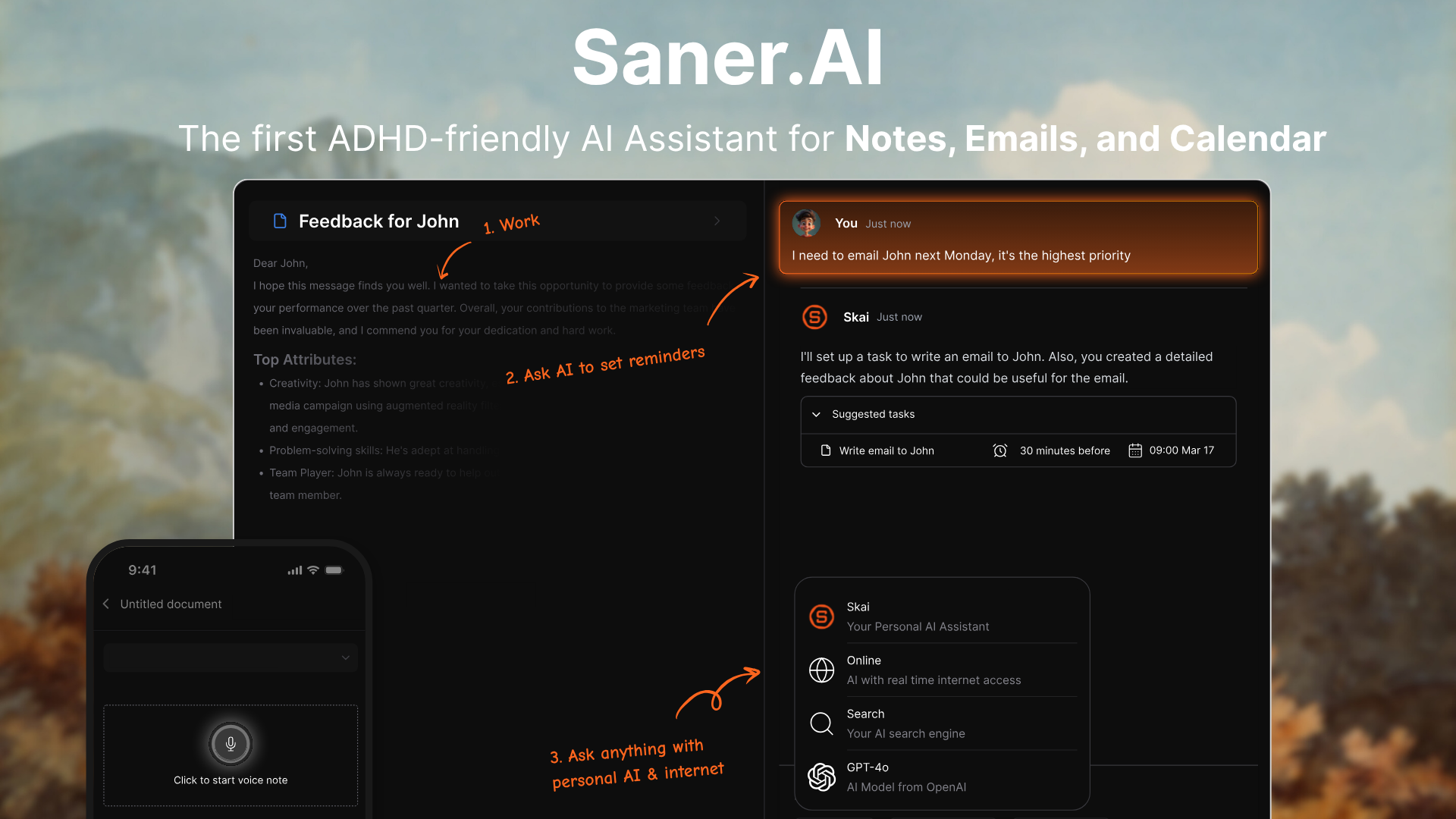
Saner.AI is an AI personal assistant designed around notes, connected information, and task management. Its assistant, Skai, can help you search saved material and turn incoming information into tasks.
Its relevance to forgetfulness is practical: it offers ways to capture something now, find it later, and keep track of what needs doing.
- Dynamic reminders: Different messages for the same unfinished task
Saner.AI's dynamic reminders vary the message for the same task. That gives each follow-up a different way of drawing your attention back to what you intended to do.
- Proactive daily planning: Bring existing commitments back into view
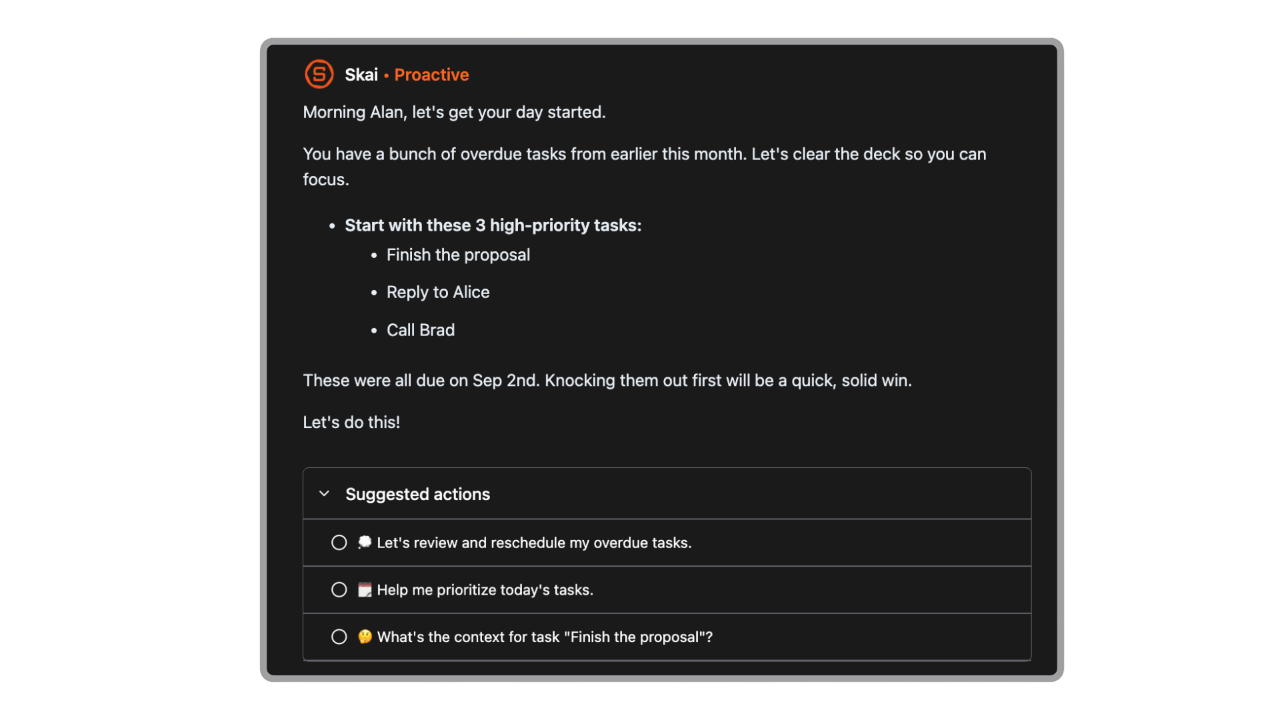
Saner.AI's assistant, Skai, can proactively suggest a daily plan based on your emails, notes, and to-dos. Skai gives you a plan when you enter the app, without requiring you to reconstruct your priorities from scratch.
- Emails to tasks: Give a request somewhere to live after you've read it
A school email arrives while you're getting ready for work. You read the trip details, think "I'll complete that form tonight," and close it. By evening, newer messages have pushed it out of sight.
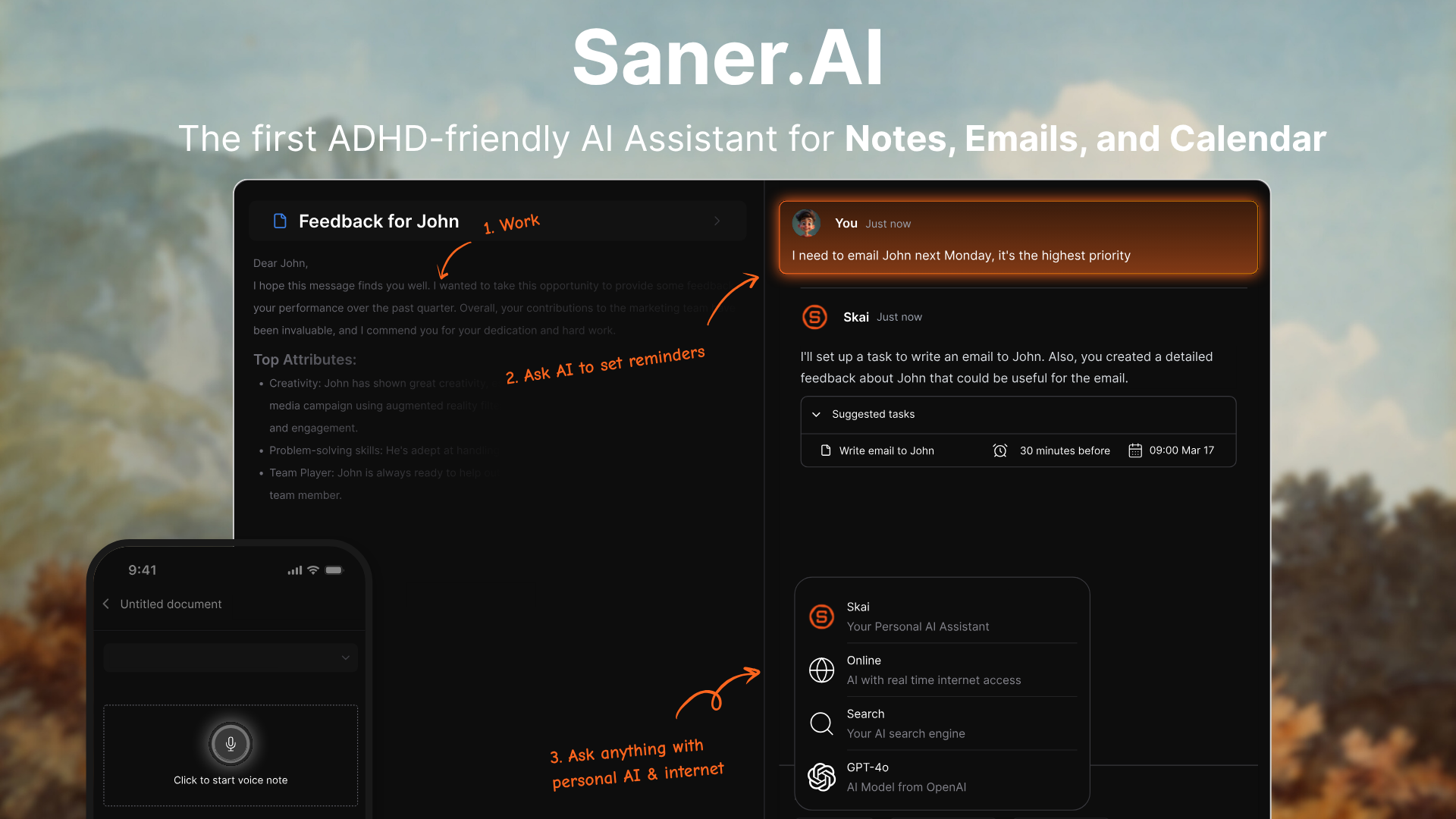
Saner.AI can suggest action items from incoming emails. You review the suggestions, adjust anything necessary, and accept them.

- Ask AI about your notes: Find information when you can't remember where it went
Saner.AI lets you ask questions about information you've saved or connected, even if you don't remember the exact wording. Its search workflow includes source citations, so you can check the original material.

- Voice capture and brain dumps: Save the thought while it's still there
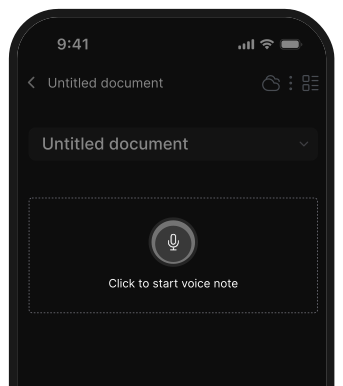
You're walking home when you remember something you need to ask the accountant. Typing a tidy note feels awkward, so you tell yourself you'll do it when you get inside. Saner.AI supports voice capture, and Skai can help identify tasks from a brain dump.
Pricing plans:
- Free
- Paid plans start at $8/month (yearly)
A realistic example: Following through after a meeting
This is an illustrative workflow, not a customer result or a tested outcome.
You finish a meeting with a rough note:
"Need revised budget for Friday. Check contractor cost with Jamie first."
Using Saner.AI, you could:
- Save the note without reorganizing it.
- Ask Skai to suggest the required tasks.
- Review the task wording and dates, including the dependency on Jamie's answer.
- Use the daily plan to bring the work back into view.
- Search the original meeting note when you need context.
You still have to contact Jamie and prepare the budget. The workflow gives the commitment a visible place to live while you're doing other things.
Conclusion
Choose a type of forgetting that happens often enough to notice.
For missed email requests, try reviewing AI-suggested tasks from a connected inbox. For scattered notes, start by adding material from one active project and asking questions about it.
Explore Saner.AI with that single use case. After a week, check whether it helped you follow through and how much effort it took to maintain. That gives you a more useful basis for deciding whether to expand the setup.
Stay on top of your work and life effortlessly
Frequently asked questions
Is forgetfulness a symptom of ADHD?
Yes. NIMH lists "frequently losing things or being forgetful in activities" among possible adult symptoms. Forgetfulness alone does not establish an ADHD diagnosis.
Does everyone with ADHD have poor working memory?
No. A meta-analysis of adult studies found working-memory differences on average, with variation across studies and testing methods. Group findings don't tell you exactly how an individual will perform.
Can I remember a conversation but still struggle to follow through?
Yes. Remembering information and planning a future action involve different demands. In the prospective-memory study described above, adults with ADHD had more difficulty developing detailed plans even though their later plan recall was similar to the comparison group's.
Can Saner.AI remind me about something I never entered?
Yes. Skai can suggest tasks from available information, including connected emails and saved notes. A commitment that exists only in your head needs to be captured first.
What if writing things down hasn't helped?
Look at what happens after capture. Can you find the note? Does it explain the action? Will you see it at a useful time?
NIMH recommends combining written reminders with organization strategies and manageable task steps. You can start by making one existing reminder more specific.
Stay on top of your work and life effortlessly